Language barriers complicate her interpersonal relationships and participation in society. She increasingly relies on diaspora networks rather than engaging with broader social or civic life. The dialectic between her need for support and her desire for recognition and participation leads her to continually reflect on questions of belonging and identity. Life in the diaspora becomes an ongoing process of social and political socialization and negotiation, through which she constructs her new identity.
You are currently viewing a placeholder content from Vimeo. To access the actual content, click the button below. Please note that doing so will share data with third-party providers.
She comes to Germany through a support program for politically persecuted scholars. Despite her well-paying fellowship, her situation is marked by uncertainty: the absence of formal employment contracts protecting workers’ rights and short-term residence permits makes her living situation precarious. Migrating with a family and children adds further challenges. Limited childcare options for full-time working women and discriminatory practices within the German bureaucracy and labour market play a role in the recurrence of the de-skilling process experienced by many migrants in the country.
You are currently viewing a placeholder content from Vimeo. To access the actual content, click the button below. Please note that doing so will share data with third-party providers.
Çağla Diner grows up in Turkey, where she completes her entire school and academic education. After finishing her studies, she moves to the United States, where she lives, conducts research, and works for several years. She then returns to Turkey and continues her academic career. In the context of increasing political repression, censorship, and restrictions on academic autonomy, she feels that she and others like her are unwelcome in Turkey. This ultimately leads to her decision to leave the country.
You are currently viewing a placeholder content from Vimeo. To access the actual content, click the button below. Please note that doing so will share data with third-party providers.
Over the years, she builds a life for herself in Germany and finds her place in society. At the same time, she has maintained her connection to Turkey. Her biography represents a life lived between two cultural contexts.
You are currently viewing a placeholder content from Vimeo. To access the actual content, click the button below. Please note that doing so will share data with third-party providers.
In her adult life, she focuses on her career, family and community involvement. Anastasia juggles responsibilities at work, at home, and within the Greek community.
You are currently viewing a placeholder content from Vimeo. To access the actual content, click the button below. Please note that doing so will share data with third-party providers.
In Germany, she begins her life without any knowledge of the language. She finds her first jobs and acquires the language through everyday life. Her subsequent life is shaped by continuous work, family responsibilities, and challenges within both professional and social contexts, including discrimination as a woman and a migrant.
You are currently viewing a placeholder content from Vimeo. To access the actual content, click the button below. Please note that doing so will share data with third-party providers.
The interviewee describes being excluded from older Croatian workers whose informal networks shaped job opportunities. She also recounts discrimination and difficult conditions with some employers, forcing her to rely on her own coping strategies.
The Notebook “Here and there”. Drawings: Božena Končić Badurina. Anthropological research: Duga Mavrinac. Layout: škart. Translation: Domagoj Živčić. Curators: Irena Bekić and Duga Mavrinac. Produced by IPAK – Research Projects and Authorial Concepts. June 2017.
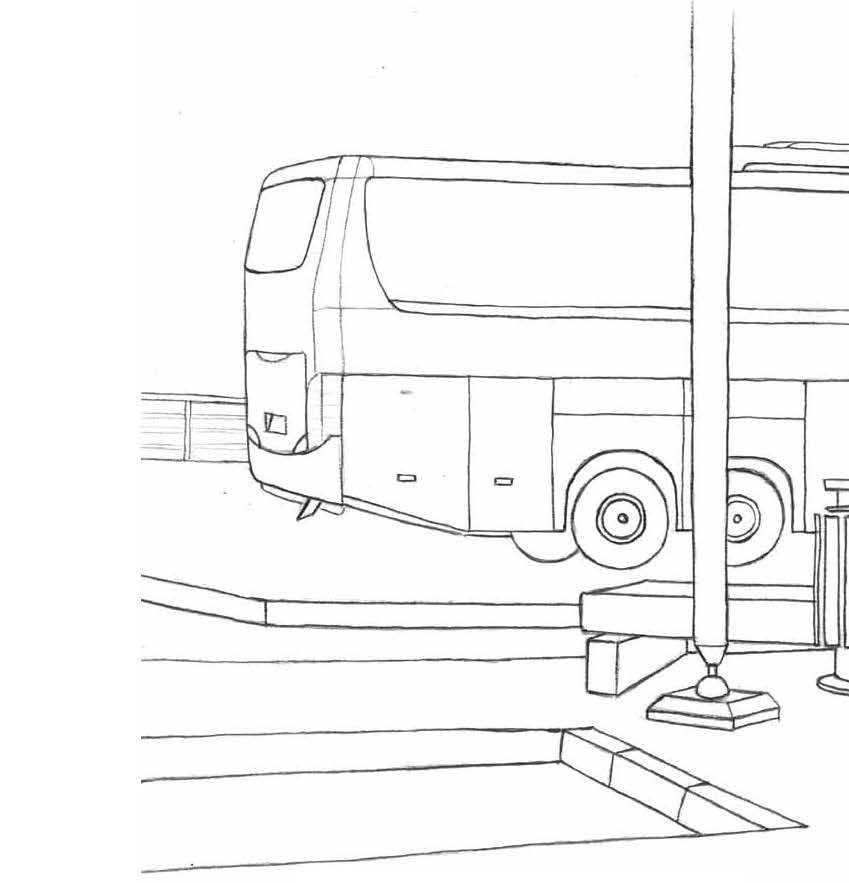
I didn’t socialize with the other Croatian care workers in the area. They weren’t interested in me; to them I was just a kid, an outsider. They were all much older, already retired or about to retire, in their sixties or seventies. They went to work because after fifty, you’re considered old and cannot get a job. That is why they left and not their daughters. We would all reach our destinations by bus and continued on by train. They all knew each other and sat next to each other. At the beginning, I just stayed quiet and watched. On the bus, little slips of paper with the numbers of potential employers were flying around. Right there on the bus, everything was decided, rules were made, partnerships formed and ended.
On the bus, little slips of paper with the numbers of potential employers were flying around. Right there on the bus, everything was decided, rules were made, partnerships formed and ended.
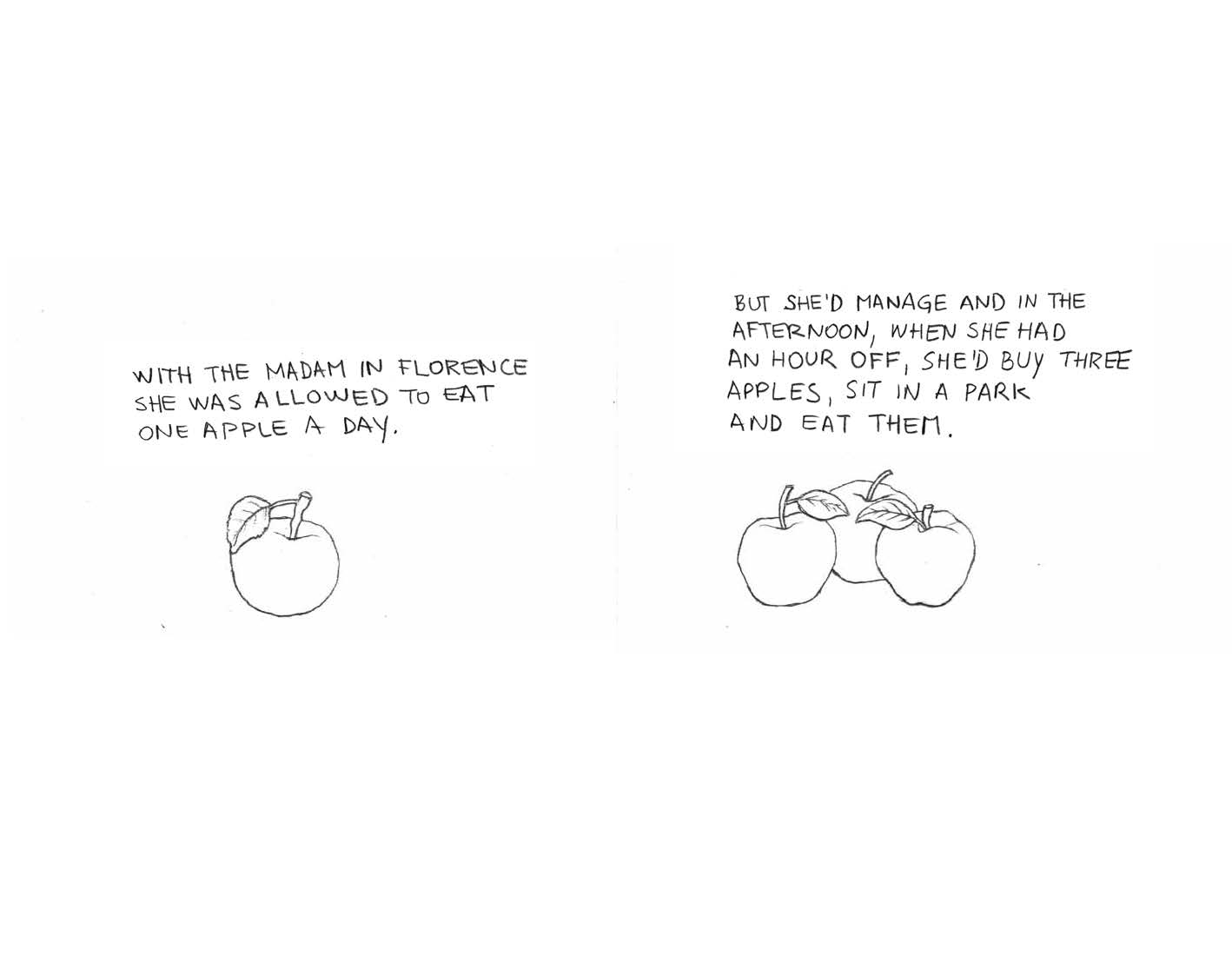
Women talked about everything: who was a good employer, who was bad, what had happened to them, and how they had managed. I experienced both good and bad myself. Some Italians saw me as the ‘ugly Slav,’ while others were kind. With some employers, I went hungry and had to bring my own food from home. If they sent me shopping, they would tell me to buy exactly two apples for them, and nothing for me. I had to figure it out on my own: take three and eat one along the way.
The interviewee underlines the importance of negotiating working conditions from the start and being informed about their rights. She addresses the specific working conditions of live-in informal care work for people affected by Alzheimer’s.
The Notebook “Here and there”. Drawings: Božena Končić Badurina. Anthropological research: Duga Mavrinac. Layout: škart. Translation: Domagoj Živčić. Curators: Irena Bekić and Duga Mavrinac. Produced by IPAK – Research Projects and Authorial Concepts. June 2017.
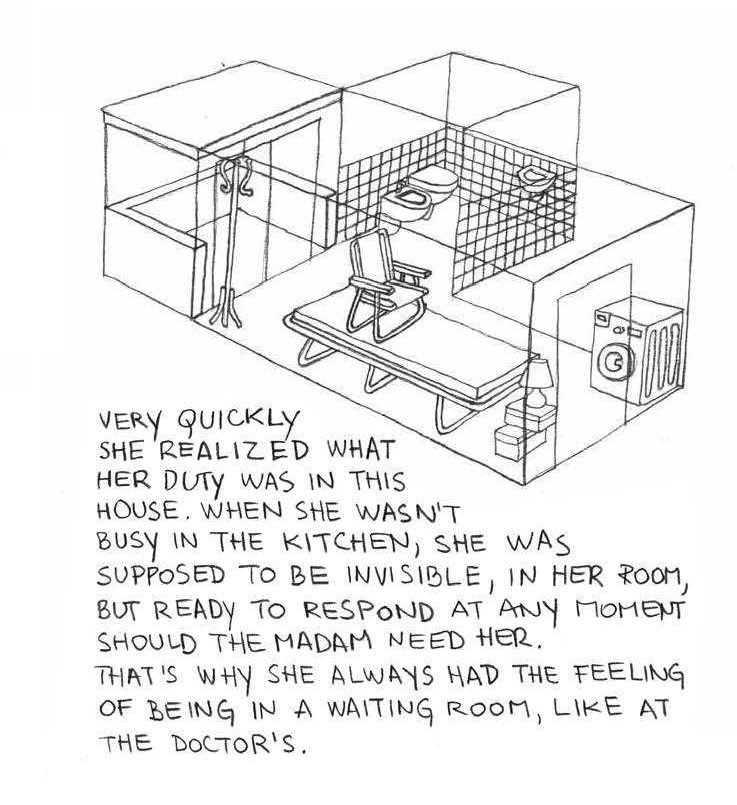
You need to negotiate; you should immediately discuss and agree on your rights and obligations, the overall working conditions, because later it becomes very difficult to change the terms you’ve accepted. If you are informed, if you know who you can turn to, you can achieve anything- but you need to know. And women need to be informed. Information is crucial. For instance, sometimes it’s easier to care for immobile people because you’re sure they can’t get up at night, fall, or wander out of the house. Those who have Alzheimer’s and are still mobile are the most demanding. You can never fully relax with them- they are unpredictable. But it’s not easy, because you are practically a stranger in someone else’s home, and you can’t relax. Sometimes they barely give you a bed or a room to sleep in. You must be there to help them, but ideally, at the same time you should be invisible.”
You need to negotiate; you should immediately discuss and agree on your rights and obligations, the overall working conditions, because later it becomes very difficult to change the terms you’ve accepted. If you are informed, if you know who you can turn to, you can achieve anything—but you need to know. And women need to be informed. Information is crucial.
Mothering across borders; fifteen days in – fifteen days out
Mothering across borders; fifteen days in – fifteen days out
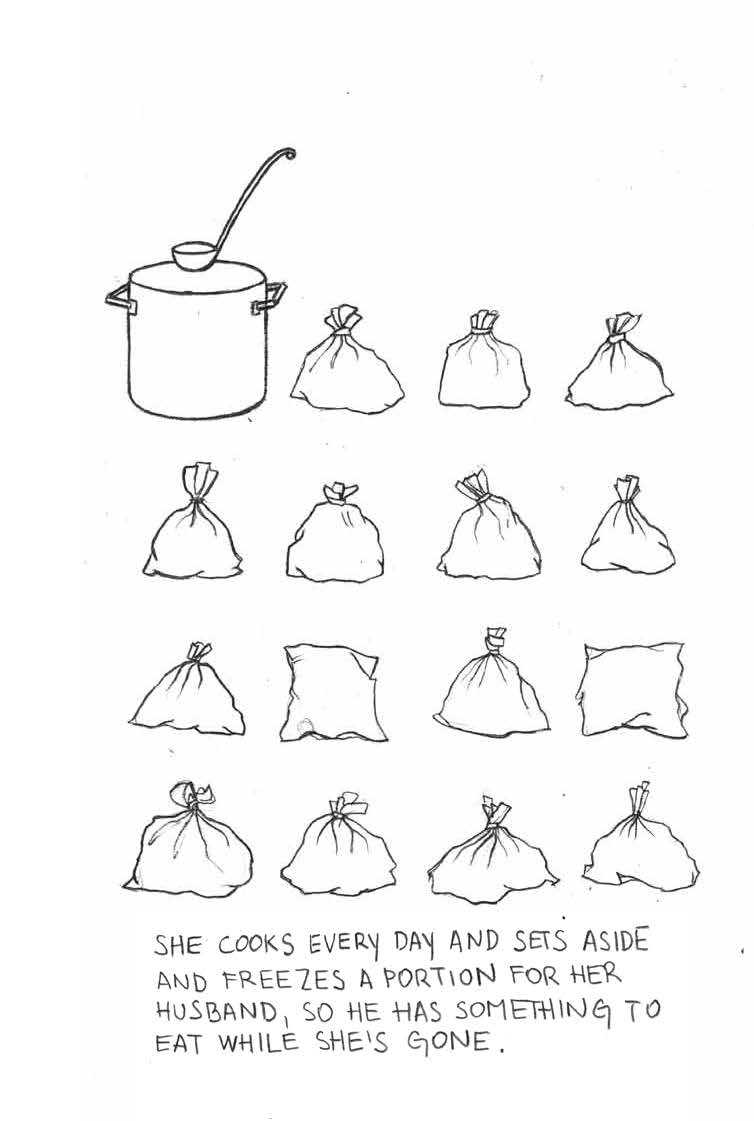
The interviewee describes how the economic consequences of the post-war transition and her husband’s forced early retirement pushed her to migrate to Italy for domestic work, leaving behind her two young sons to support the family. She reflects on the emotional toll of migration, expressing deep guilt and lasting pain over the impact her absence had on her children despite her efforts to provide for them financially.
The Notebook “Here and there”. Drawings: Božena Končić Badurina. Anthropological research: Duga Mavrinac. Layout: škart. Translation: Domagoj Živčić. Curators: Irena Bekić and Duga Mavrinac. Produced by IPAK – Research Projects and Authorial Concepts. June 2017.
All of this is a consequence of the war and everything we went through. The first time I left for Italy, I left behind two sons, aged seven and nine…I started working in 1997, when I was thirty-three years old. It all happened very suddenly, headlong. My husband was injured at work, at a glass factory, and he was constantly on sick leave. The factory was later bought by a German company, and with privatization, workers slowly lost their rights. They told him he could not remain on sick leave on and off again, and that it would be better if he took early retirement. So, we had to decide what to do. He retired, but the State informed us that it would take a full year to process the paperwork, meaning there would be no pension during that time. With two children in school, I panicked! PANICKED! And as I’m impulsive by nature, that is just how I am, and we all knew that women were leaving for Italy, it was very sudden, and I left to work in Verona, fifteen days in, and fifteen days out. And that’s how it was. It’s hard for a man to find works especially if he is older. A woman just switches to another family, and either way, she ends up serving and caring for others…
It’s hard for a man to find works especially if he is older. A woman just switches to another family, and either way, she ends up serving and caring for others…
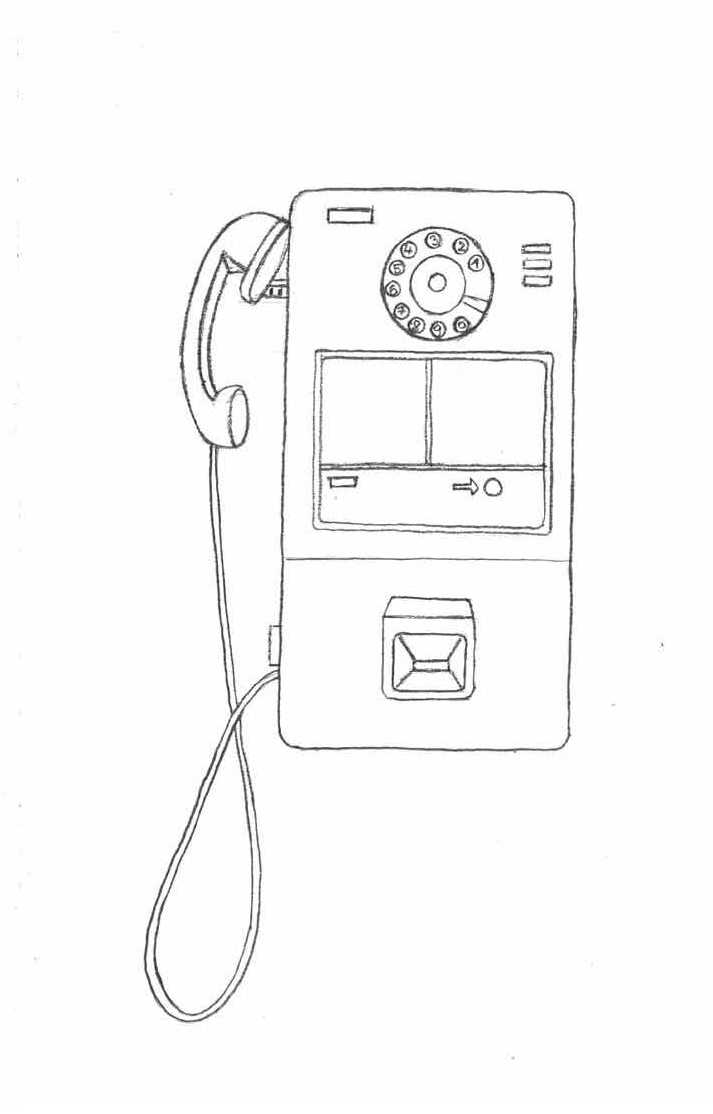
But once in Italy, I was not doing well psychologically, hanging out in a phone booth like a madwoman. Out of guilt for leaving my small children, I tried to make up for it – I bought them things to compensate, and I was aware of it. Let’s be clear: I went to earn a living, but I never came home without gifts, clothes, toys, or sweets.
My older son suffered greatly because I wasn’t there. When I was home, he would constantly come to me — something I will never forget — and hug me. I would say, ‘But we hug all the time,’ and he replied, ‘But you couldn’t hug me when you were in Italy!’
I still remember those words today. It felt like a slap, especially since before I left I hadn’t even been allowed to touch him without his permission. For everything that has happened later in his life, I blame myself. I know that isn’t good, that it is not only my fault, but still I feel it is because of me and that I am to blame because I wasn’t there.”
Rejecting the notion of migration as a purely economic choice, Silvia Henao explores the deep emotional pain and loneliness of adapting to a new country. She frames her experience in Belgium as a grueling personal challenge, ultimately emerging as a survivor who transformed hardship into self-reliance.
You are currently viewing a placeholder content from Vimeo. To access the actual content, click the button below. Please note that doing so will share data with third-party providers.