A Challenging Start
A Challenging Start
After migrating to Belgium, Ayşe faced various challenges in her new environment.
“The house where the six of us lived, on Halvemaanstraat, was very small. On the ground floor, at the front, there was a small, damp room. At the back, there was a living room with a three-seater sofa and a separate armchair, a small cabinet, a coal stove, and a table for four people. The kitchen was no more than one and a half square meters, with only a sink and a stove. Through the kitchen, you could reach a small courtyard with a single toilet. Upstairs, there were only two bedrooms. The father and his brothers slept in one room, and the other room became ours. In our room, there was a sponge mattress and a blanket on the floor, without sheets. There was a wardrobe that was used by everyone in the house. Getting used to the environment and the domestic situation was not easy. The small space, and being the only woman among five men, was something I had to adapt to.”
In our room, there was a sponge mattress and a blanket on the floor, without sheets. There was a wardrobe that was used by everyone in the house. Getting used to the environment and the domestic situation was not easy. The small space, and being the only woman among five men, were things I had to adapt to.
“I wanted to learn the language as quickly as possible and stand on my own two feet. I no longer wanted to be dependent on others, and (I wanted) to follow my classes effortlessly. In Turkey, I lived independently and was respected by those around me. Here, I was dependent on others and had to beg for respect. A teacher at school had told me that during the summer months I could take a free Dutch course organized by Ghent University for international students. I enrolled. In early July I started the Dutch course. There were students from different backgrounds, even an ophthalmologist from Turkey who had come here for specialist training at the University Hospital Ghent. He was married to a Belgian woman, named Vera. A few years later, she took part in the Turkish language courses that I gave to Belgian teachers. The Dutch course was taught by Professor De Keukelaere. He was very kind and understanding. He gave explanations in English and French, but I did not know any English and my French was not sufficient to understand everything. When he noticed that I did not understand something, he tried to explain it to me with gestures and body language. When I came home, I looked up the meaning of all the words from the course in the dictionary and made word lists that I could practice at every free moment, such as while cooking or on the bus to and from class. I found it difficult to take proper notes in class. One day, the physics teacher asked: ‘Who is willing to lend Ayşe their notes?’ I hadn’t expected it at all, but several hands went up. I was so happy.”
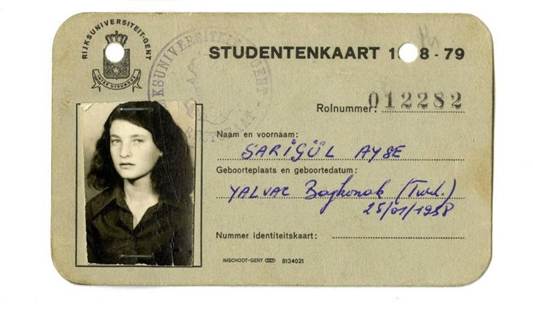
I wanted to learn the language as quickly as possible and stand on my own feet. I no longer wanted to be dependent on others, and (I wanted to) to follow my classes effortlessly. In Turkey, I lived independently and was respected by those around me. Here, I was dependent on others and had to beg for respect.”
A Challenging Start
“Het huis waarin wij met zes personen verbleven in de Halvemaanstraat was heel erg klein. Beneden was aan de voorkant een klein vochtig kamertje. Aan de achterkant was een woonkamer met een driezitsbank en een losse fauteuil, een klein kastje, een kolenkachel en een tafel voor vier personen. Verder was er een keuken van hooguit anderhalve vierkante meter met alleen een spoelbak en een fornuis. Via de keuken kon je naar het kleine koertje met één toilet. Boven waren er slechts twee slaapkamers. De vader en zijn broers sliepen in de ene kamer, en de andere kamer was van ons. In onze kamer lag een sponsmatras en een deken op de grond, zonder lakens. Er stond een kledingkast die door iedereen in het huis werd gebruikt. Wennen aan de omgeving en de huiselijke situatie was niet gemakkelijk. De kleine ruimte en het feit dat ik de enige vrouw tussen vijf mannen was, maakte dat ik moest wennen.”
In onze kamer lag een sponsmatras en een deken op de grond, zonder lakens. Er stond een kledingkast die door iedereen in het huis werd gebruikt. Wennen aan de omgeving en de huiselijke situatie was niet gemakkelijk. De kleine ruimte en het feit dat ik de enige vrouw tussen vijf mannen was, maakte dat ik moest wennen.